
Ordering photochromic flat-top bifocal lenses starts with separating three parts of the specification: the light-adaptive function, the bifocal design, and the lens material. A product name alone does not settle the segment size, prescription range, color, or coating needed for an order.
For optical retailers and lens distributors, the most useful next step is a written specification that the supplier can check line by line. This guide explains the terminology and provides a request-for-quotation checklist for that conversation.
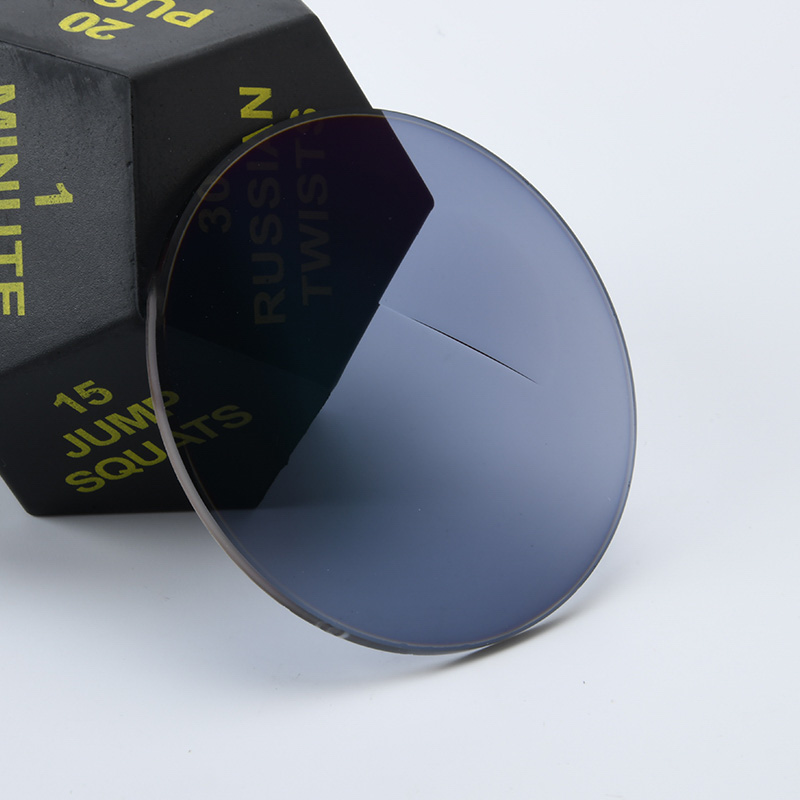
LensPT product photograph. The visible tint is an appearance reference, not a measurement of photochromic performance.
What Are Photochromic Flat-Top Bifocal Lenses?
Photochromic describes a lens function: its tint changes in response to activating light and reverses as conditions change. Activation depends on the technology and conditions, including light exposure and temperature. IOT’s explanation of photochromic lenses provides background on this behavior. A general description does not establish the darkening or fading performance of a particular product.
Flat-top bifocal describes the optical design. The lens combines a main distance-vision area with a separate near-vision segment whose upper edge is straight. The segment is also commonly called a D-segment because of its shape. Warby Parker’s guide to bifocal lenses explains this distinction within the broader bifocal category.
Polycarbonate describes the material. Photochromic and polycarbonate are separate specifications; neither term should stand in for the other on an order form.
That distinction matters when using abbreviations. Write “photochromic” in full when requesting a quote, then list the material and refractive index separately. This gives the supplier a clearer starting point than “PC bifocal lenses.”
Material and Refractive Index: The LensPT Reference
The LensPT product information used for this guide identifies polycarbonate as the material and 1.59 as the nominal refractive index. See the LensPT flat-top bifocal product page for the product reference.
For a photochromic order, ask LensPT to confirm the complete combination in writing. Material and index do not, by themselves, confirm the available segment width, lens diameter, prescription range, color, or coating package.
The same approach helps when moving from a sample to a larger order: use a dated specification or quotation that identifies the exact product combination you want to purchase.
Specifications to Confirm Before Ordering
Use the following fields to describe your requirements. They are items to confirm, not a list of all options available from LensPT.
| Order field | What to put in the inquiry | What to ask the supplier to confirm |
|---|---|---|
| Lens function and design | Photochromic, flat-top bifocal | The exact product designation and segment design |
| Material and index | Polycarbonate, nominal index 1.59 | That this combination applies to the quoted photochromic product |
| Supply form | Finished prescription lenses or semi-finished blanks, as required | Which form is available and what processing remains |
| Segment dimensions | Required segment width and any relevant fitting specification | Available dimensions and the reference drawing or specification |
| Lens diameter | The diameter required by your lab or order | Available diameters for the selected product |
| Prescription and addition | Required sphere, cylinder, and near addition, where applicable | Available ranges and any combination limits |
| Color | The requested photochromic color | Available colors and how the supplied sample is identified |
| Coatings | The coating package your order requires | Compatibility and availability for this exact lens combination |
| Processing | Intended edging, grooving, drilling, or other lab work, if relevant | Applicable processing instructions and restrictions |
| Commercial terms | Quantity, destination, packaging, and requested delivery timing | Minimum quantity, price basis, lead time, shipping terms, and quote validity |
For example, an inquiry that specifies material and index but omits the near addition still leaves an important part of a finished prescription order unresolved. A stock-blank inquiry may need a different set of details. State the supply form early so the supplier can check the appropriate fields.
Avoid assuming that a size or coating shown for another bifocal model is available for the photochromic version. Keep any alternative proposed by the supplier on a separate line so it does not silently replace your original requirement.
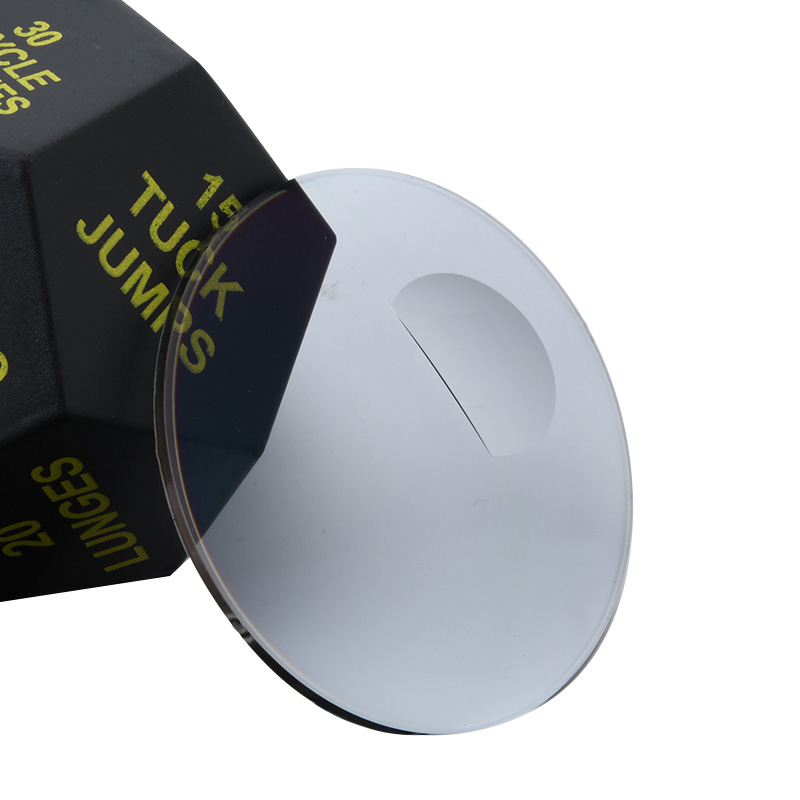
The visible segment helps illustrate the bifocal design. The photograph does not establish its dimensions.
How to Ask About Photochromic Performance
Two product photographs can show different appearances without providing a controlled comparison. Lighting, exposure, viewing angle, and the lens condition can all affect what a photograph shows. Use images to discuss appearance, then request product-specific data for performance questions.
If activation or fading is important to your purchase, ask for:
- The exact product, color, material, and coating tested.
- The light source, exposure duration, and temperature used.
- The measurement used to describe the clear and activated states.
- The conditions and endpoint used for any quoted darkening or fading time.
A time value is difficult to interpret without knowing what counted as “dark” or “clear” in that test. Ask the supplier to provide the conditions alongside the result rather than relying on an isolated number.
If your customers have a particular use environment in mind, include it in the inquiry. The supplier can then explain what evidence is available for that situation. This guide does not establish a specific LensPT activation time, tint depth, or performance in every environment.
A Photochromic Bifocal Lens RFQ You Can Reuse
Copy the following request into an email and complete the fields that apply to your order:
Subject: RFQ — Photochromic Flat-Top Bifocal Lenses
Please quote photochromic flat-top bifocal lenses for our optical business.
Requested material and index: Polycarbonate, nominal index 1.59. Please confirm this combination for the quoted product.
Supply form: Finished prescription lenses or semi-finished blanks — please confirm availability for our requirement.
Order details to provide: Segment dimensions, lens diameter, sphere/cylinder and ADD requirements where applicable, photochromic color, coatings, quantity, packaging, delivery destination, and required timing.
Please identify any unavailable specification and list alternatives separately. Include current product specifications, relevant processing instructions, sample availability, minimum order quantity, price basis, lead time, shipping terms, and quotation validity.
If photochromic performance data are available, please include the test conditions and the exact product configuration tested.
Before approving the quotation, compare it with your original request. Resolve missing fields and substitutions in writing, and keep the confirmed specification with the order record. If you evaluate a sample, record which configuration it represents so that your feedback refers to the product being quoted.
Request Current Specifications from LensPT
Start with a product-specific specification discussion. Review the flat-top bifocal lens reference, then contact the LensPT sales team with the completed inquiry.
Include your delivery destination and intended order quantity so the team can confirm the relevant supply terms. The quotation should identify the available photochromic configuration and any alternatives before you place an order.