
Before ordering photochromic lenses, compare the lens configuration, the conditions used to activate it, and the endpoint used to measure fading. A darkness photograph or a speed claim is incomplete without that context. For distributors, eyewear brands, and optical laboratories, the useful question is: can these sample results support the same purchasing decision?
Start by asking each supplier for a documented comparison under agreed conditions. Record the material, index, design, coating, temperature, light exposure, and visible light transmittance. Then link the results to the exact sample and specification you intend to approve.
Supplier and method disclosure: LensPT publishes this guide and supplies optical lenses. There are no other commercial collaborations associated with this article. It draws on public manufacturer documentation and an original blank comparison sheet. No physical lens testing was performed for this guide; the sheet is an editorial procurement tool, not a laboratory test report.
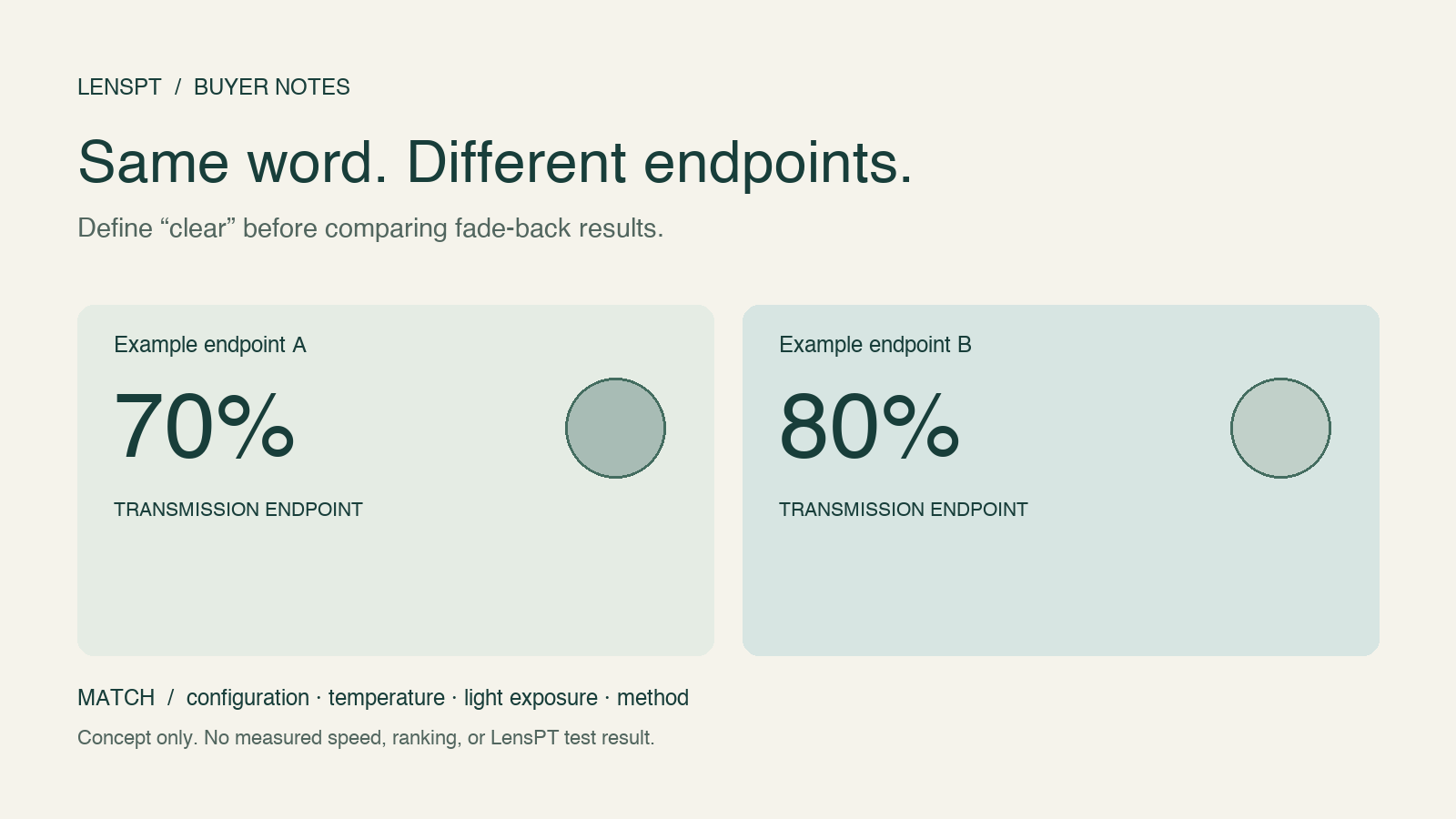
Conceptual illustration. The endpoints are examples from cited manufacturer documentation; the graphic shows no measured speed or LensPT performance.
Match the lens configuration before comparing performance
“Photochromic” does not finish a purchase specification. Identify the design, lens material, nominal refractive index, color, coating, and blank requirements before evaluating samples. Keep the sample ID beside those fields so a later quotation can refer to the same configuration.
For example, LensPT’s PC photo gray lenses page describes a single-vision polycarbonate configuration with a nominal index of 1.59 and HC, HMC, or custom coating options. Its blue-cut progressive photo gray lenses page describes a 1.56 progressive configuration with its own coating choices. These are different product configurations, not two interchangeable samples for a speed comparison.
Use those pages to begin a configuration discussion. Ask LensPT to confirm the current specification and availability for your inquiry; a listed option does not establish the conditions, results, or delivery terms of your order.
If you intentionally compare different materials or designs, write that purpose into the record. Such a comparison may help select a product range, but it should not be described as isolating the performance of the photochromic treatment alone.
Define the fade-back endpoint
Visible light transmittance describes the proportion of visible light transmitted through the lens. A higher percentage means more visible light is transmitted. When reviewing a report, keep its measurement method and definition alongside the percentage rather than judging lens appearance from a photograph alone.
The phrase “time to clear” needs an endpoint. In its GEN S FAQ, Transitions specifies fade-back to 70% transmission at 23°C for stated gray polycarbonate and CR39 configurations with a premium anti-reflective coating. Read the Transitions GEN S FAQ.
ZEISS uses a different endpoint in a PhotoFusion X comparison footnote: 80% transmission at 23°C, with the cited comparison specifying gray 1.50-index CR607 lenses in HC-only form. The footnote describes average fade-back speed from the fully activated state. Read the ZEISS PhotoFusion X documentation.
These examples explain why headline speeds cannot simply be placed side by side. The endpoints and configurations differ. They do not establish which brand is faster under a common method, and they provide no performance result for LensPT lenses.
For your own comparison, ask the supplier to name the starting state, transmission endpoint, elapsed-time definition, and temperature. Also distinguish an elapsed time in seconds from an average speed expressed as percentage points of transmission per minute. They answer related but different questions.
A usable request is: “Please report the time from the end of the agreed activation exposure to the agreed transmission endpoint, with the sample configuration and temperature stated.” Choose the endpoint with the supplier or test laboratory before reviewing results. Do not choose it afterward to favor one sample.
Set the temperature and activation conditions
Photochromic lenses respond to activating light. ZEISS describes UV-driven activation and notes that outdoor darkness depends on temperature and UV intensity. That makes the conditions part of the result, rather than background information that can be omitted.
When discussing photochromic lenses and temperature, ask what was controlled and recorded during both activation and fading. A report that lists temperature only for one stage leaves the other stage unclear. Ask the source to resolve that gap before treating two results as comparable.
For photochromic lens activation time, record the light source, its stated spectrum and intensity, exposure duration, starting state, and target transmission. “Dark after exposure” does not identify how dark, after how long, or under which illumination.
Keep special-use requests separate. If a buyer wants information about performance behind a vehicle windshield or under a particular indoor light source, request documentation for that exact condition. Do not extend an outdoor activation result to another setting without supporting evidence.
A quick side-by-side demonstration can help a team formulate questions. For purchasing approval, use an agreed measurement method and a report tied to the samples. This guide does not prescribe test equipment settings or replace a laboratory procedure.
Use a sample comparison sheet
The following blank sheet is designed to keep conditions and results together. Copy it into your inquiry or sample review document, then add a column for each supplier or configuration. Empty cells mean information is needed; they are not zero values or failed results.
| Record for each sample | Sample A | Sample B | Check before comparison |
|---|---|---|---|
| Sample ID and specification revision | Can the result be traced to the quoted product? | ||
| Design, material, index, coating, color, and blank size | Are differences intentional and documented? | ||
| Measurement method, equipment, and report ID | Were comparable methods used? | ||
| Temperature during activation and fading | Are both stages documented? | ||
| Activating light source, spectrum, intensity, and exposure duration | Was the exposure comparable? | ||
| Initial visible light transmittance | Is the starting condition defined? | ||
| Darkened transmittance at a stated exposure time | Is the observation time the same? | ||
| Fade-back endpoint and elapsed time to reach it | Are endpoint and clock start the same? | ||
| Residual tint and color reference | Was appearance assessed under agreed conditions? | ||
| Special-use conditions, if requested | Does the evidence cover the intended setting? | ||
| Sample owner, review date, and approval decision | Is the decision tied to this specification version? |
This original table was checked using synthetic editorial scenarios: different endpoints, a missing temperature, and matching comparison conditions. Those checks tested whether the record exposes missing information; they were not physical lens tests.
For example, if one supplier reports fading to 70% transmission and another to 80%, mark the results as not directly comparable. Request a shared endpoint or a report that supports comparison at that endpoint. Do not fill the gap by estimating one time from the other.
If the conditions match, the records may support a documented comparison. That still does not create an acceptance threshold. Your team must agree on the requirement and decide whether the submitted evidence addresses it.
Keep appearance and approval decisions explicit
Darkness, fading, and color appearance deserve separate fields. A sample may satisfy an agreed transmission requirement while its indoor appearance does not match the reference your team selected. Recording these decisions separately makes the reason for approval or rejection clearer.
For residual tint, ask when the observation was made after activation, under what lighting, and against which reference. If color consistency matters to your range, agree on the reference and evaluation method before sample review. Avoid treating a phone photograph as a numerical transmission result.
For photochromic lens sample approval, use an explicit outcome: approve the stated version, request revised samples, or hold the decision pending missing evidence. Record the responsible reviewer and retain the corresponding specification and report identifiers.
The commercial quotation should reference that same configuration. If a supplier later proposes a different coating, material, color, or design, ask which earlier results still apply and whether another sample review is needed. This is a recommended purchasing record, not a claim about any supplier’s existing quality procedure.
Questions to resolve before an order
Can buyers compare photochromic lenses by fade-back time alone?
No. For photochromic lenses, fade-back time becomes useful only when the endpoint, starting condition, configuration, temperature, and method are known. A shorter reported time to a different endpoint is not enough to rank samples.
Does a darker sample automatically suit the order better?
Treat darkness as one agreed requirement. Review the documented clear-state appearance, fading, configuration, and intended-use conditions as well. This guide does not assign a universal weighting to those purchasing priorities.
What if the supplier has only photographs or a demonstration video?
Use them to identify questions, then request the missing method and measurement information. If comparable evidence is unavailable, record that limitation in the approval decision instead of turning a visual impression into a measured performance claim.
Prepare a focused LensPT inquiry
If you are deciding how to compare photochromic lenses for a new range or repeat order, send the configuration and comparison questions together. Include lens design, material or nominal index, coating, color, diameter or blank requirements, quantity, and destination market. For progressive lenses, identify the required design or corridor information as well.
Add the temperature, activation conditions, transmission endpoint, and appearance reference you want discussed. If these are undecided, mark them as questions for the supplier rather than inserting assumed values.
Send your photochromic lens specification and comparison requirements to LensPT. The sales team can discuss the requested configuration and quotation. Availability, sample arrangements, and commercial terms require confirmation for the individual inquiry.