
Choose the supply format by the work your business can complete after delivery. Finished uncut lenses have their optical surfaces completed, but still need to be edged and fitted to a frame. Semi-finished lens blanks require further optical surfacing before they become finished prescription lenses.
For buyers comparing finished vs semi-finished lenses, the first question is therefore operational: who will complete the remaining work, and is that work included in the quotation? An optical distributor and a surfacing laboratory may need different products even when they specify the same lens material.
Publisher disclosure: LensPT supplies optical lenses and publishes this guide. No other commercial partnership is associated with this article. The comparison uses public industry and manufacturer documentation, with an original purchasing framework. No physical lens testing or production trial was performed. The examples below are hypothetical purchasing situations.
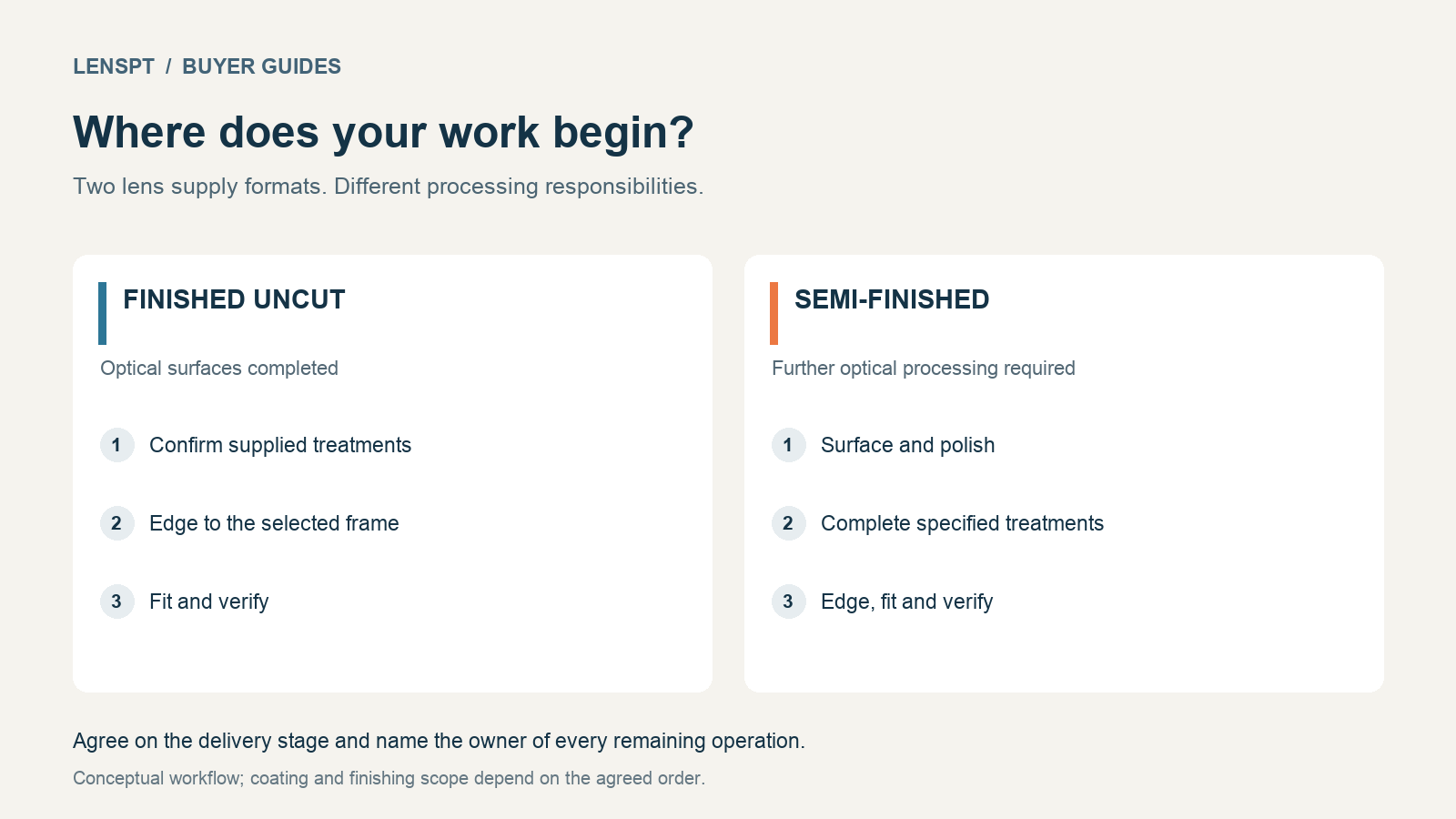
Supply-stage illustration. Coating and finishing responsibilities must be confirmed for the actual order; the diagram does not describe a specific LensPT production service.
What the two supply formats actually mean
Finished uncut lenses
A finished uncut lens already has its required optical surfaces. “Uncut” means it has not yet been shaped to the selected frame. The Vision Council distinguishes the finishing department, which handles edging and mounting, from the surfacing work needed for semi-finished blanks. See its Dispensing Guide.
Stock supply is a common way to purchase finished lenses in specified powers and configurations. However, finished describes the processing stage, while stock describes availability. A custom prescription lens can also arrive finished and uncut.
That distinction matters in an inquiry. Ask whether you are buying an available stock item or a lens produced against an individual order. Then specify whether edging is included.
Semi-finished lens blanks
A semi-finished blank has a prepared optical surface and material remaining for further processing. In the production route described by ZEISS, the front surface is already formed and the back surface is machined for the prescription, followed by polishing and the specified treatments. Its manufacturing explanation illustrates why a blank is an input to further production.
Do not treat a blank as a ready-to-edge finished prescription lens. Before ordering, have the receiving laboratory confirm that the exact blank is suitable for its intended design and processing route.
These terms describe manufacturing stages. They do not, by themselves, rank optical quality or establish that one supplier’s product will outperform another’s.
Compare the work remaining, not just the item price
Use this table to clarify the quotation. The process distinctions follow the sources above; the questions are an original purchasing framework, not a universal specification.
| Purchasing question | Finished uncut lenses | Semi-finished lens blanks | Basis |
|---|---|---|---|
| Is optical surfacing still required? | Optical surfaces are already completed for the ordered lens. | Further surfacing and polishing are required. | Vision Council; ZEISS |
| Can the item go straight into a frame? | Edging and fitting remain. | Optical processing must be completed before final edging and fitting. | Vision Council |
| What should the supplier identify? | Exact finished configuration, powers, diameter and ordered treatments. | Exact blank code and geometry, material, prepared surface and intended processing route. | Editorial purchasing checklist |
| Who should confirm compatibility? | The team responsible for the order and finishing requirements. | The receiving surfacing laboratory, against the supplier’s blank information. | Editorial responsibility allocation |
| What coating work remains? | Confirm which treatments are already supplied and whether further work is requested. | Confirm the supplied surface condition and responsibility for subsequent treatments. | ZEISS process example; order-specific confirmation |
| What should be compared commercially? | The quoted delivered item plus any excluded finishing work. | The blank plus the agreed downstream processing and finishing work. | Editorial comparison method |
A blank quote and a finished-lens quote cover different amounts of work. Put them on a common basis before judging the price difference. State the final deliverable you want, then ask each supplier to list included and excluded operations.
For example, a quotation may cover lenses delivered uncut to a local finishing facility. Another may cover lenses edged to supplied frame information. Record that difference rather than assuming that both prices reach the same endpoint.
This guide does not assign a standard cost saving or lead time to either route. Obtain those figures for the actual order, processing partner and delivery destination.
Use a decision order instead of a universal winner
Give processing capability priority over price. If no confirmed partner can finish a blank, a lower blank price does not resolve the missing production step.
Next, check whether the required configuration is available in the proposed format. Request the current supply matrix or blank specification, then have the relevant technical team review it. Material and nominal refractive index alone do not identify a complete lens order.
Finally, compare replenishment and commercial terms. Ask about order quantities, availability, packaging and dispatch arrangements for the exact configuration. Separate confirmed terms from estimates.
This approach gives different priorities to different buyers without assigning arbitrary numerical weights:
- A distributor should first establish what its customers can process, then review the finished assortment and replenishment terms.
- A surfacing laboratory should first confirm blank and process compatibility, then consider its production plan and purchasing terms.
- A brand outsourcing production should first define the delivered result and the party responsible for each operation.
Three purchasing situations
These examples illustrate the decision framework. They are not customer cases or measured business outcomes.
A wholesaler serving stores that handle edging. The wholesaler wants repeat orders of defined lens configurations. Finished uncut lenses are a route to investigate because the stores can perform the remaining finishing work. The wholesaler still needs confirmation of the available power range, diameter, treatments and delivery terms.
A laboratory carrying out prescription surfacing. The lab wants blanks for a defined production program. Semi-finished supply is a route to investigate after its technical team approves the blank specification. The purchasing team should retain the approved product code and revision so a later substitution can be reviewed.
A brand with no in-house lens processing. The brand wants a delivered product for a particular eyewear program. Neither a stock-lens list nor a blank price is enough until the production arrangement is defined. The brand can ask a supplier or contracted lab to quote the required endpoint, with surfacing, coating, edging and fitting responsibilities made explicit.
A business can use more than one supply route. The purchasing record should make clear which route applies to each item.
Put the delivery stage on the request for quotation
Use a separate request line for each supply format. The following fields form a finished and semi-finished lens RFQ checklist; they are suggested purchasing fields rather than a substitute for the receiving lab’s technical specification.
- Delivered format: finished uncut, semi-finished blank, or another explicitly agreed endpoint.
- Product identification: supplier code, lens design, material, nominal index and specification revision.
- Format-specific details: required powers and diameter for finished lenses; supplier blank specifications and receiving-lab approval for semi-finished items.
- Surface and treatment status: what is supplied, what remains to be done, and who performs it.
- Acceptance responsibility: who checks the incoming item and who approves the result after subsequent processing.
- Commercial scope: quantity, packaging, destination, quoted lead time and excluded services.
For each unresolved field, name the person or team who will answer it. Keep a missing value marked as pending rather than filling it with a customary value from a different order.
The same discipline helps when comparing stock lenses vs RX lenses. Specify whether the inquiry concerns an available assortment or a made-to-order prescription job, and identify the delivery stage separately. LensPT’s RX lens page is a starting point for discussing a made-to-order request; it does not confirm every service or configuration for your order.
Questions buyers often need to resolve
Does “finished” mean ready to wear?
No. A finished uncut lens still needs edging and fitting. Ask for the actual delivered format instead of relying on the word “finished” alone.
Can every semi-finished blank produce every prescription or design?
Do not assume that it can. Ask the receiving laboratory to approve the exact blank for the intended job. This guide does not provide blank-selection calculations or clinical prescribing advice.
Should a buyer always choose the lower unit price?
First check that both quotations cover the same final deliverable. If one excludes processing that the other includes, obtain the missing scope and charges before comparing totals.
Send LensPT a request with the processing scope attached
LensPT describes its supply range as including finished and semi-finished optical lenses. Start with the optical lens range and identify the format you need.
Include the design, material or nominal index, quantity and destination market. Add the delivered stage, the work your own team or partner will complete, and the operations you want included in the quote.
Discuss your lens supply format and quotation requirements with LensPT. The sales team can confirm the available configuration and commercial scope for the inquiry. Request written confirmation before treating a listed product or general capability as an agreed order specification.