
Blue cut lenses are easy to recognize in a sales presentation and surprisingly hard to compare. One sample flashes violet under a lamp. Another looks almost like a standard clear lens. Both may carry the same “blue cut” label, but that does not make them equivalent.
The short answer is simple: a blue cut lens is a spectacle lens designed to reduce the transmission of selected short-wavelength visible light. It can do this through a functional coating, an absorbing lens material, or a combination of the two. The useful questions are how much light it filters, over which wavelength band, and what the wearer sees through the finished lens.
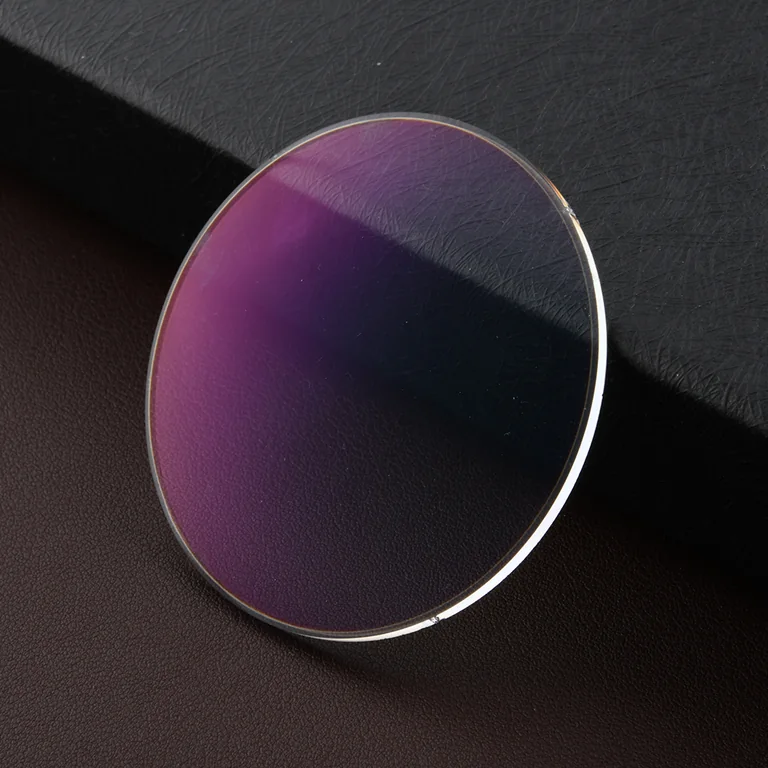
Multicoat Isolation range at a glance
The Multicoat Isolation range discussed in this guide is built for optical buyers who need an aspheric blue cut lens with a defined coating and index program.
| Specification | Available configuration |
|---|---|
| Lens design | ASP (aspheric) |
| Coating | SHMC |
| UV designation | UV420 |
| Refractive indices | 1.499, 1.56, 1.59, 1.61, and options up to 1.67 |
These labels make the range easier to shortlist, but they do not replace the approved product data sheet. Power range, diameter, substrate, coating tests, and spectral limits should be confirmed for each index before ordering.
What are blue cut lenses?
Blue cut lenses, also called blue light filtering lenses or blue light blocking lenses, reduce part of the violet-to-blue region of visible light before it reaches the eye. They are not the same thing as blue-tinted fashion lenses or blue-mirror sunglasses. Most everyday blue cut prescription lenses are intended to remain clear or nearly clear.
The wording on a package can be misleadingly simple. Blue light covers a band of wavelengths, not one single test point. A supplier who states a blocking percentage should also state the wavelength range, measurement method, lens material, coating, and reference condition. Without those details, two percentages cannot be compared fairly.
UV filtration and blue-light filtration sit next to each other on many sales sheets, but they are separate claims. In this range, UV420 is the supplied product designation. Buyers should still verify the wavelength interval, transmission limit, and test method behind that designation rather than infer a percentage from the name.
How blue cut lens technology works
There are three common construction routes.
Coating-based filters
A functional multilayer coating reflects selected short-wavelength light at the lens surface. This route often produces the blue or purple residual reflection seen when the lens is tilted under a bright light. The lens may still look clear in transmission.
Coating design matters. A dark reflection can be visually obvious without proving how broad or strong the filter is. It can also affect how the wearer’s eyes look in photographs and video calls. Both the spectral curve and the cosmetic appearance belong in the sample approval process.
In-material filters
An absorbing compound can be incorporated into the lens substrate. Instead of reflecting the selected wavelengths, the material absorbs part of them. This approach may reduce the visible blue reflection, although the lens can take on a faint warm or yellow cast depending on the formulation and filter strength.
Hybrid designs
Some lenses combine an absorbing substrate with a functional coating. A hybrid design gives the manufacturer more control over the transmission curve and residual color, but the label alone still says little about the finished result. The approved sample and test report remain the useful references.
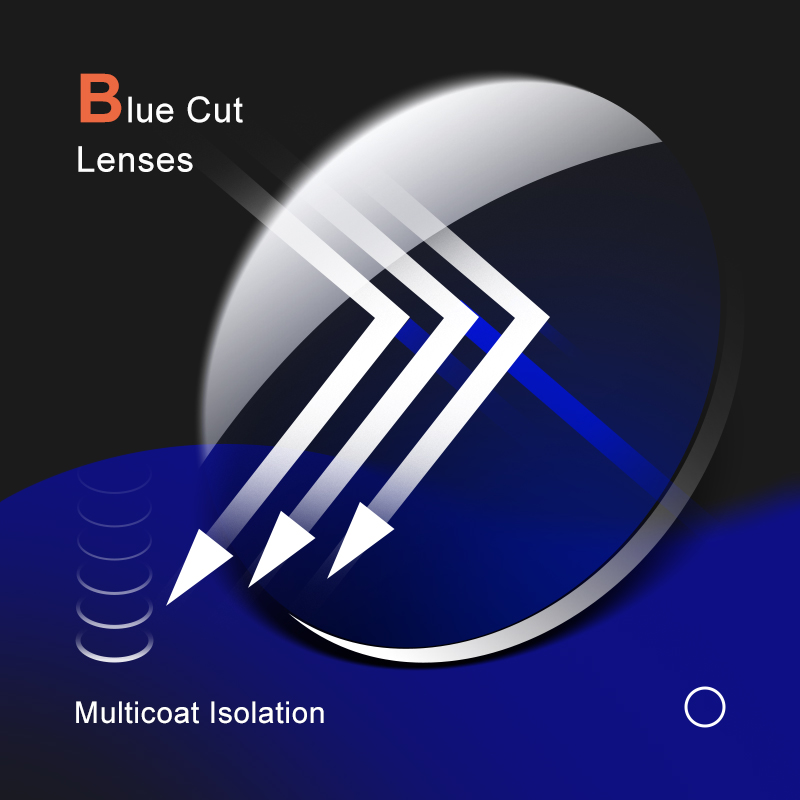
The supplied Multicoat Isolation artwork illustrates the coating-based route. Selected blue-violet light is redirected at the front surface while the rest of the visible spectrum passes through the lens. It is a helpful explanation of the concept, but buyers should use measured data to approve performance.
What SHMC, UV420, and ASP mean in this lens range
The three terms describe different parts of the finished lens. Keeping them separate makes quotations and sample approval much clearer.
SHMC coating
SHMC is the coating specification for this Multicoat Isolation range. In common optical-lens terminology, it refers to a super-hydrophobic multi-coating: a multilayer anti-reflective treatment finished with an easy-clean surface. The abbreviation is not a universal performance grade. Buyers should place the required reflectance, adhesion, abrasion, cleanability, and residual-color criteria in the approved specification.
UV420 designation
UV420 identifies the requested UV and short-wavelength filtering configuration. It should not be turned into a blocking percentage unless a test report defines the wavelength band and measurement method. Ask for the complete spectral transmission curve for the exact lens index and coating being purchased.
ASP lens design
ASP means aspheric. It describes the lens geometry, while SHMC describes the surface treatment and UV420 identifies the filtering configuration. An aspheric design can support a flatter profile and better peripheral optics than a comparable spherical design, but the finished result still depends on prescription, base curve, diameter, frame choice, and fitting.
Available refractive indices
The ASP blue cut lens program is available in 1.499, 1.56, 1.59, 1.61, and higher-index options up to 1.67. Refractive index alone does not identify the substrate or its impact performance, so confirm the material, power range, diameter, and applicable market requirements for each option.
Blue cut lenses vs anti-glare lenses
Blue cut and anti-glare are often sold together, which is why the names get mixed up. They solve different optical problems.
| Feature | Blue cut lens | Anti-glare or anti-reflective lens |
|---|---|---|
| Main purpose | Reduces transmission in a selected short-wavelength band | Reduces reflections from the lens surfaces across a broader part of visible light |
| How it is made | Functional coating, absorbing material, or both | Thin-film interference coating |
| Typical appearance | Clear or slightly warm lens with a possible blue-violet residual reflection | Usually clear with a faint green, blue, or other residual reflection |
| Can the two be combined? | Yes | Yes |
This Multicoat Isolation option uses SHMC, while the blue cut function addresses selected short-wavelength transmission. Ask the supplier to identify each layer and function separately. “Multicoat” should lead to a coating specification, not a guess based on reflection color.
Do blue cut lenses work?
Optically, a properly measured filter does change spectral transmission. The clinical question is narrower: does wearing it reliably reduce digital eye strain, improve sleep, or protect the retina?
The best evidence does not support strong promises. A 2023 Cochrane review of 17 randomized controlled trials found that blue-light filtering spectacles may make little or no difference to short-term visual fatigue compared with non-filtering lenses. The evidence for sleep outcomes was uncertain, and the available trials did not establish long-term retinal protection.
More recent research has not changed the practical message. A 2025 randomized crossover study compared blue-filtering lenses, anti-reflective CR-39 lenses, and uncoated CR-39 lenses during a 120-minute tablet task. Among the 26 participants, the blue-filtering lenses did not reduce dry-eye signs or symptoms.
This does not mean every blue cut product is identical or that no wearer can prefer one. It means the promise should match the evidence. A lens manufacturer can demonstrate a transmission profile, coating quality, color appearance, cleanability, and production consistency. It should not turn those measurable properties into an unsupported medical guarantee.
For wearers, blue cut lenses are best presented as an optional lens feature rather than a treatment for screen-related symptoms. Anyone with persistent eye discomfort, headaches, blurred vision, or dryness should speak with an eye-care professional.
What should buyers verify before approving a blue cut lens?
The purple reflection is easy to photograph. The following details are more useful when you need a repeatable product.
1. A complete spectral transmission curve
Ask for the curve rather than a headline blocking percentage. The report should identify the tested lens, wavelength range, equipment or test method, and measurement condition. If the supplier uses a weighted metric, request its definition.
2. The filtering route
Confirm whether the filter sits in the substrate, the coating, or both. This affects residual reflection, base color, processing, and the way performance should be checked after production.
3. Transmitted color and residual reflection
Review the lens against white paper, skin tones, a display, and neutral indoor lighting. Then check the front and back reflections at several angles. A spectrophotometer report cannot replace this cosmetic approval, and a visual sample cannot replace the report. You need both.
4. The rest of the coating stack
Blue-light filtering is only one part of a finished lens. For this SHMC option, confirm the anti-reflective performance, hydrophobic finish, hard-coat construction, and any durability tests relevant to your market. If a claim is important to the purchase order, put the test method and acceptance limit in the specification.
5. Lens range and processing compatibility
Confirm the diameter, power range, tinting restrictions, edging requirements, and substrate for every index in the Multicoat Isolation ASP program. Approve representative plus, minus, and cylinder samples when those powers are commercially important. A plano demonstration piece does not tell you how every finished prescription will look.
6. Lot-to-lot consistency
Agree on tolerances before the production order. Keep an approved reference sample and define how incoming lots will be checked. This is especially important when residual color is part of the product identity.
Can a blue-light torch prove that a lens is genuine?
A torch-and-card demonstration can show that two lenses interact with a narrow light source differently. It cannot describe the full transmission curve, overall filter strength, color neutrality, coating durability, or optical quality. The result also depends on the torch wavelength and the test card.
Use the demonstration as a sales aid if it suits your market. For product approval, use spectrophotometer data and an agreed test method.
Screen comfort still depends on the whole setup
Digital discomfort has several common causes: an outdated prescription, prolonged near focus, reduced blinking, dry air, reflections, small text, and poor monitor position. One lens feature cannot address all of them.
The US Occupational Safety and Health Administration recommends placing a monitor directly in front of the user, with the top line at or below eye level, at a comfortable viewing distance that is generally 20 to 40 inches (50 to 100 cm). Its computer workstation guidance also recommends regular distance breaks and blinking to reduce fatigue and dryness.
This context makes product communication more believable. Sell the lens for the optical properties you can verify, and give wearers practical habits that do not depend on a coating claim.
Frequently asked questions
Are blue cut lenses and blue light blocking lenses the same?
The terms are generally used for the same product category. “Blue cut,” “blue filter,” and “blue light blocking” are marketing names, so the actual filter profile can vary by manufacturer. Compare specifications rather than names.
Should a blue cut lens look blue?
Not necessarily. A coating-based lens may show a blue or violet reflection while remaining nearly clear to the wearer. An in-material filter may have less surface reflection and a slightly warmer transmitted color. Appearance alone does not prove performance.
Are blue cut lenses the same as anti-glare lenses?
No. A blue cut feature reduces selected short-wavelength transmission. An anti-reflective coating reduces unwanted lens-surface reflections. A finished lens can include both.
What does SHMC UV420 ASP mean?
SHMC identifies the super-hydrophobic multi-coating, UV420 identifies the requested filtering configuration, and ASP means the lens has an aspheric design. These terms describe separate features and should be supported by a product specification.
Which refractive indices are available?
The Multicoat Isolation ASP blue cut lens range includes 1.499, 1.56, 1.59, 1.61, and higher-index options up to 1.67. Confirm the substrate, diameter, and power range available within each index.
Can blue cut lenses prevent digital eye strain?
Current clinical evidence does not show a reliable short-term reduction in digital eye strain for the general population. Correct prescription, sensible screen distance, glare control, blinking, and regular breaks still matter.
Can blue cut lenses be worn all day?
Many clear or near-clear blue cut lenses are designed for everyday use, but suitability depends on the prescription, filter profile, transmitted color, and the wearer’s needs. Color-critical users should evaluate a sample, and individual concerns belong with an eye-care professional.
What information should I send when requesting a quotation?
Include your target market, lens design, refractive index, power range, coating level, expected quantity, packaging needs, and destination. If you already have a target transmission curve or an approved reference sample, send that too.
Specify the Multicoat Isolation lens you actually want
The supplied Multicoat Isolation image presents a clear ASP lens with a visible blue-violet residual reflection. The available program uses SHMC, carries the UV420 designation, and covers refractive indices from 1.499 through options up to 1.67. Final construction and performance should be confirmed in the current product specification.
Planning a SHMC UV420 ASP blue cut lens range? Send our lens team your required refractive index, power range, diameter, quantity, packaging needs, and destination. We will confirm the available Multicoat Isolation specification, test data, sample route, and quotation.
The reflection starts the conversation. The curve, coating specification, and approved sample make the order repeatable.