
A useful CR39 sun lens RFQ does more than name a material and request a price. It defines the intended market, frame geometry, color target, polarization and coating choices, sample acceptance method, commercial assumptions, and what must happen if the bulk order changes after approval.
Use the checklist below before asking suppliers to quote. It is designed for brand, distributor, and lens-buying teams sourcing plano sun lenses. It is not consumer prescription advice, a supplier ranking, a test report, or a determination that a product meets any destination-market requirement.
Commercial disclosure: LensPT publishes this supplier-side educational guide and offers sun-lens products. The framework is an editorial procurement checklist built from cited public sources. It is not presented as a LensPT factory SOP or as evidence of hands-on testing.
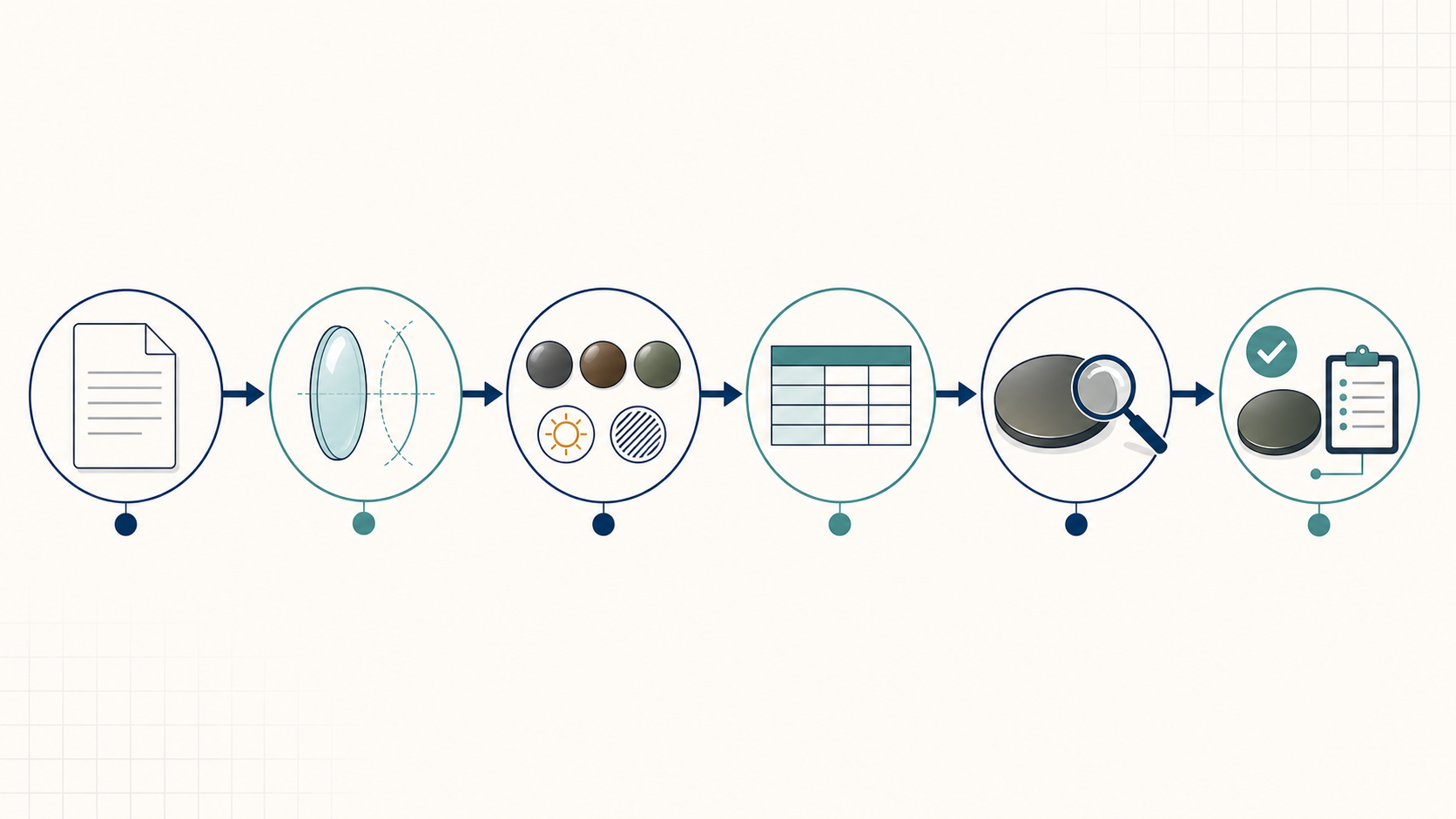
The short version: lock six decisions before comparing quotes
Treat a quotation as comparable only when every supplier receives the same inputs:
- destination market and the requirement or standard version the buyer wants addressed;
- lens material, lens type, diameter, base curve, thickness reference, and frame geometry;
- color or tint reference, solid or gradient treatment, and any buyer-defined transmission target;
- polarization and coating requirements, including the evidence or method requested for approval;
- sample quantity, approval criteria, and the identity of the approved master sample; and
- order quantities, packaging, lead time, delivery terms, payment terms, quote validity, and change-control expectations.
Do not insert a universal tolerance because another program used it. Record the buyer’s target, a named reference sample, or a supplier-confirmed tolerance and measurement method.
A copy-ready CR39 sun lens RFQ table
Complete the “buyer input” column before sending the inquiry. If a field is intentionally open, label it “supplier to propose” instead of leaving it blank.
| RFQ field | Buyer input | What the supplier should return |
|---|---|---|
| Program and destination | Project code, destination market, intended use, plano or powered lens | Scope assumptions and any exclusions |
| Requirement reference | Standard, regulation, customer protocol, or retailer specification with version/date | Applicable document version and proposed evidence |
| Material | CR-39; identify any allowed alternative separately | Material designation and any alternative clearly separated |
| Geometry | Diameter, base curve, thickness reference, frame drawing or fit data | Offered geometry, tolerances, and measurement method |
| Color and tint | Solid/gradient, physical swatch or coded reference, transmission target if applicable | Sample method, target range, and expected lot-control approach |
| Polarization | Required/not required; orientation or verification request if relevant | Offered construction and proposed approval evidence |
| Coating | Required coating stack and appearance/performance request | Offered coating, limitations, and care notes |
| Sample plan | Quantity, variants, delivery date, approval fields | Sample lead time, labeling, and resample conditions |
| Commercial terms | Forecast, trial quantity, order quantities, packaging, Incoterm, destination | MOQ, quantity breaks, lead time, payment/shipping terms, quote validity |
| Change control | Fields that cannot change without written approval | Notification and reapproval process |
This structure is intentionally vendor-neutral. It helps expose assumptions; it does not claim that every supplier offers every option.
1. State the destination-market boundary first
“UV protection required” or “export standard” is too vague for a sourcing document. Name the destination, product type, applicable requirement, edition or amendment, and the evidence you expect the supplier to return. If your organization has a retailer or customer protocol, include that exact revision as well.
For example, the official scope page for ISO 12312-1:2022 describes plano sunglasses, clip-ons, and replacement filters for general use and also lists exclusions. That scope statement is a reason to define the product and market precisely—not a basis for assuming that every CR-39 lens program falls under the same requirement.
ISO also lists ISO 12312-1:2022/Amd 1:2026 as a published amendment. Put the version or amendment requested by the buyer into the RFQ, then have a qualified owner confirm applicability for the destination market. This guide does not perform that legal or conformity review.
2. Reconcile lens geometry with the frame program
A CR39 sun lens specification should not separate the blank from the frame it must fit. Send a frame drawing, dimensional data, or another controlled geometry reference whenever possible.
Public CR-39 sun-lens pages show why these fields belong in the inquiry. Hortron’s sun-lens specifications expose material, base curve, diameter, color or tint, and polarization as configurable fields. These are examples of fields to define, not LensPT specifications and not universal defaults.
A second public example, Japan Eyewear’s CR-39 page, lists base curve, diameter, center or edge thickness, and solid or gradient color choices. The useful procurement lesson is to state the geometry and appearance basis together.
At minimum, record:
- lens type and material;
- finished or blank diameter;
- requested base curve;
- thickness reference and where it is measured;
- frame model, drawing revision, wrap, and edge or mounting constraints; and
- which dimensions the sample approval will verify.
If the frame design is not frozen, say so. Ask the supplier to identify which quoted values are provisional and what must be rechecked after the frame is fixed.
3. Make color, tint, polarization, and coating reproducible
Color names such as “gray,” “brown,” or “G15-style” can start a conversation, but they are weak approval records on their own. Use a physical reference, a controlled digital or numeric target when your process supports one, and defined viewing or measurement conditions. For a gradient, specify orientation and the points or zones that will be compared.
For polarization, state whether it is required. If it is, ask the supplier to propose the construction, orientation control, and approval evidence rather than assuming that the word “polarized” resolves every performance question.
For coatings, separate what must be present from what must be demonstrated. Name the coating stack, appearance expectation, handling requirement, and any buyer-owned protocol. If there is no approved test method or threshold, request a proposal and mark it for technical review; do not convert a marketing description into an acceptance criterion.
A practical way to write the color line
Instead of:
Gray gradient, normal darkness.
Write:
Gray gradient; match physical reference
REF-GR-02; top, midpoint, and lower-zone targets to be proposed against the buyer’s stated measurement method; sample approval required before bulk production.
The second version makes open decisions visible. Replace the example reference and method with your own controlled inputs.
4. Keep commercial fields tied to the same specification
Price comparisons break down when one quote assumes a stock lens and another assumes a custom tint, coating, packaging format, or inspection plan. Put the specification revision on the quotation request and require suppliers to list deviations.
A public sunglasses RFQ guide from LumiShades includes lens material and tint, a compliance-standard input, MOQ and quantity breaks, sample and bulk lead times, payment and shipping terms, and quote validity. Its scope is broader than lenses, but those commercial fields are still useful prompts for a sunglass lens RFQ.
Ask each supplier to return:
- sample price and any setup or tooling charge;
- MOQ and quantity breaks for the exact quoted revision;
- sample and bulk lead times, with the start point defined;
- packaging unit and labeling assumptions;
- payment, shipping, and delivery terms;
- quote validity; and
- every exclusion, substitution, or supplier-proposed change.
This is the TCO boundary of the guide. It identifies cost inputs but does not publish market price benchmarks or assume that the lowest unit quote produces the lowest program cost.
5. Approve a sample against a written record
Public sample-request flows also make the information gap visible. For example, Vena Optics’ lens sample request asks for lens type, index, coating, tint, quantity expectations, and target market. A buyer can go one step further by binding the delivered sample to an approval record.
Use a sample ID that connects the physical lens to the RFQ revision. The approval record should state:
- sample ID, RFQ revision, supplier, and receipt date;
- frame or fixture used for the fit check;
- geometry fields checked and the method used;
- color/tint comparison reference and conditions;
- polarization and coating checks requested by the buyer;
- cosmetic acceptance fields and allowed defect reference, if one exists;
- packaging and label checks;
- deviations accepted for the sample but not for bulk; and
- approver, decision, date, and retained master-sample location.
This is an editorial sign-off framework, not a claim about a particular factory’s process. Adapt it to the buyer’s quality system and qualified technical review.
6. Treat repeat orders as controlled revisions
An approved sample should not become a vague memory. State which changes require notice and whether they trigger a new sample, document review, or both.
Common change-control fields include material source, geometry, tint recipe or reference, polarization construction, coating stack, packaging, inspection method, and production site. The buyer decides which fields are controlled. The supplier should identify a proposed change before production, provide the reason, and wait for the required approval path.
Three hypothetical risks explain why this matters:
- a color request cannot be reproduced because the original approval used only a color name;
- a base curve or diameter is quoted before it is reconciled with the final frame geometry; or
- bulk production changes after sample approval without a new sign-off.
These are decision-framework scenarios, not reported LensPT or customer incidents.
Sample-approval decision: accept, conditionally accept, or resample
Use one of three explicit outcomes:
| Decision | Use it when | Record next |
|---|---|---|
| Accept | Every required field passes | Identify the sample as the controlled reference |
| Conditionally accept | Listed deviations are accepted for a defined scope | Write the separate bulk requirement and its owner |
| Resample | A required field is unresolved, changed, or outside the approved boundary | State what must change before the next review |
Avoid “looks fine” as the entire record. A useful decision names the sample, the checked revision, the approver, the conditions, and what the supplier may manufacture next.
When this checklist is not enough
Pause and obtain qualified help when the product type, prescription status, destination-market requirements, test method, or safety implication is unclear. This article does not replace optical design review, laboratory work, regulatory advice, customer-specific protocols, or a supplier quality agreement.
It is also not a market-wide product comparison. Teams seeking CR-39 sun lens options can review LensPT’s existing product page, while buyers who need to compare sun lens programs can start from the broader Sunlens family page. Product availability and commercial terms should be confirmed for the submitted specification and destination.
Send a specification, not just a product name
Before contacting a supplier, complete the RFQ table, attach the geometry and color references, name the destination-market requirement, and define who will approve the sample. That preparation makes supplier assumptions easier to spot and repeat-order changes easier to control.
To discuss a quotation or sample path with LensPT, send the lens specification, quantity, and destination market. The LensPT sales team can respond to the inquiry; final supply terms depend on the submitted requirements.