
By LensPT Team · Published November 20, 2026
Lens blank diameter determines whether the lab can cut the full frame shape from an uncut lens at the required position. Begin with the frame’s effective diameter and the required centration for each eye. Then ask the lab to check the trace against the usable area of the specific blank. The second step is especially useful when a stock diameter is close to the preliminary estimate.
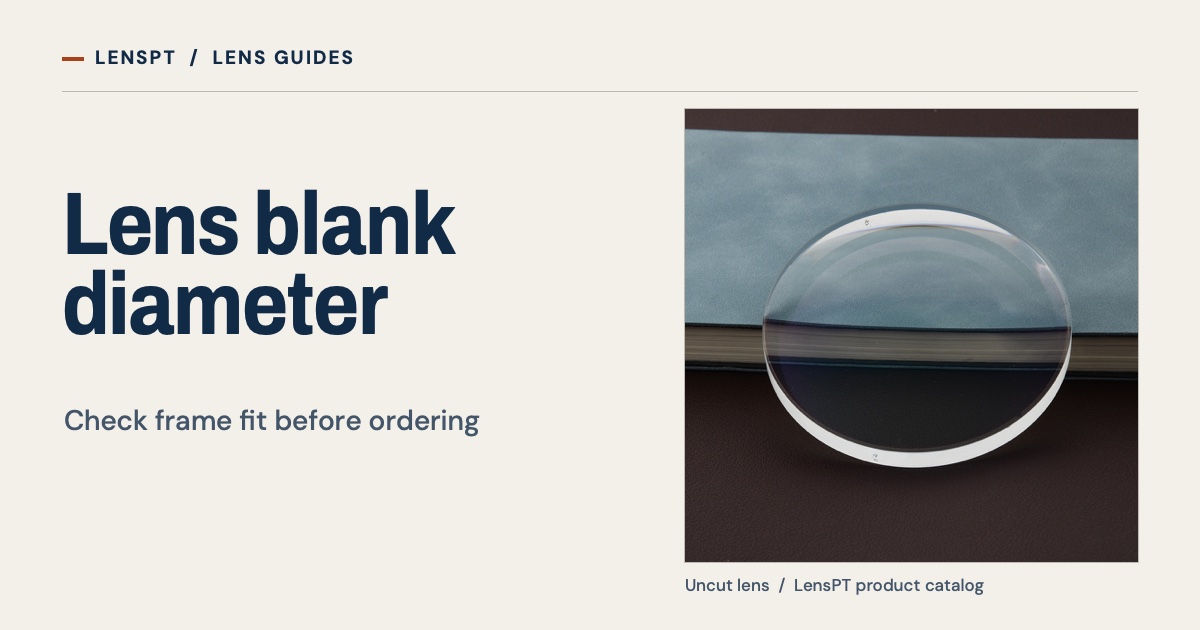
Table of Contents
1. Identify the frame dimensions that affect lens blank diameter
Use the effective diameter (ED) of the frame opening. It is twice the distance from the boxing center to the farthest point on the traced edge. On a narrow or angular frame, the farthest point may be a corner. The horizontal eye size alone can miss it.
The centration requirement shifts where the frame shape sits on the uncut lens. For a preliminary single vision check, compare the frame’s horizontal geometric center on each side with the intended centration point. Record left and right separately. Different monocular pupillary distances can give the two openings different offsets even on a symmetric frame. Optical Training Institute, minimum blank size calculation (PDF)
| Dimension or record | What it tells the buyer | Where to get it |
|---|---|---|
| Eye size, A (mm) | Horizontal width of the lens opening in the frame. | Frame drawing or boxed trace. |
| Effective diameter, ED (mm) | Diameter of the smallest circle centered on the boxing center that covers the traced edge. | Frame trace or a lab’s ED measurement. |
| Centration and fitting height (mm) | Where the lab positions the lens design relative to each opening. | Order layout supplied by the optical team. |
| Nominal blank size (mm) | The diameter on the quotation for the requested SKU. | Supplier’s availability list or specification. |
| Usable area | The part available to cut the shape under the lab’s processing conditions. | Supplier layout information and lab cut-out confirmation. |
2. Estimate a round blank diameter for each eye
For a simple round single vision blank with a horizontal offset, a common preliminary estimate is ED + 2 × |horizontal decentration|, in millimeters. The absolute value gives the magnitude of the shift. Use the supplier layout and an actual trace when the design reference point, vertical placement or blank geometry affects the usable area.
Consider a symmetric frame with a 68 mm distance between its geometric centers and a 61 mm effective diameter per opening. For this horizontal-only example, each frame center is 34 mm from the middle of the frame. The right monocular PD is 30 mm and the left is 31 mm. The numbers illustrate the calculation.
| Eye | Horizontal shift | Preliminary diameter |
|---|---|---|
| Right (OD) | 34 − 30 = 4 mm | 61 + 2 × 4 = 69 mm |
| Left (OS) | 34 − 31 = 3 mm | 61 + 2 × 3 = 67 mm |
If the quoted lens blank diameter is 70 mm in this example, the right eye has a 1 mm difference between the nominal size and the estimate. That is a reason to send the actual trace to the lab and request its cut-out decision, including any required process allowance. Put both eye results on the request so the supplier can identify the limiting side.
3. Confirm cut-out on the actual lens and frame
Ask the lab to align each traced eye shape to the required lens position and check that the outline fits inside the proposed usable area. Send the exact trace revision, lens design, material, power and diameter on the quote. If you are comparing two diameters, identify the stock code for each one and ask which configuration the lab can process.
When checking lens blank diameter for a progressive, include the design’s fitting reference and near zone. The supplier’s layout chart or electronic cut-out check places the outline relative to the fitting cross. Essilor’s Varilux guide gives an example of matching the fitting cross for the selected frame to a diameter layout chart. Use the equivalent references for the design being quoted. Essilor cut-out and layout example (PDF)
LensPT asks for diameter when quoting clear single vision and progressive lenses. Start with the appropriate product page and ask which diameters are available for the specific design, power range, index and finish. When an order is close to the limit, put the result of the trace check on the sample approval record. LensPT single vision specifications · LensPT progressive specifications
Questions from optical buyers
Does the same lens blank diameter work for every power in a stock range?
Ask for the availability list by product, power and diameter. Then group your representative frames and jobs against the list. Have the lab check the boundary cases before approving stock to cover an entire assortment.
Can I use the same method for semi-finished blanks?
The frame outline and centration are still relevant. Include who will surface the blank and who will edge it, then ask the surfacing lab to confirm the actual blank and design limits before selecting the supply format. Finished and semi-finished lens supply formats
Send a diameter check with your RFQ
Include the frame trace, left and right layout, material and nominal index, lens design, coating, requested diameter and quantity. For a stock assortment, attach representative jobs and identify the range they cover. Ask for the available diameters by SKU and record the lab cut-out result before releasing the order. Request diameter and configuration details from LensPT