
By LensPT Team · Published November 7, 2026
Spherical and aspheric describe surface-design characteristics. In the usual spectacle-lens comparison, an aspheric surface departs from a spherical profile, allowing the designer to manage the lens shape and optical behavior. The word “aspheric” does not identify the material, refractive index, coating or complete ordering specification.
For distributors and eyewear brands comparing spherical vs. aspheric lenses, the next step is to identify the actual designs being offered. Ask what changes for the intended product range and what must remain the same when comparing samples. A flatter-looking lens photograph cannot answer those questions on its own.
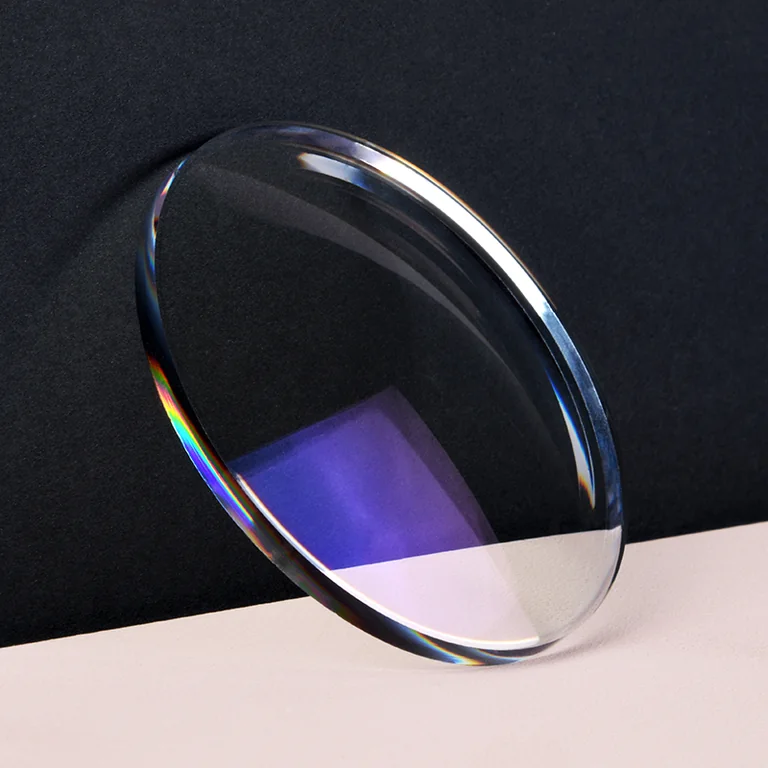
Publisher disclosure: LensPT supplies optical lenses and publishes this guide. It draws on public manufacturer explanations and existing LensPT information, with an original design-comparison worksheet. No physical optical tests, wearer trials or production calculations were performed. The cover is an existing LensPT catalog image; its appearance does not identify a spherical or aspheric design.
What is the difference between spherical and aspheric lenses?
A spherical surface follows a spherical shape. An aspheric surface varies from that shape. In a supplier discussion, identify which surface and named lens design the description concerns; the abbreviated category is not a full geometry specification.
ZEISS’s Single Vision Aspheric explanation describes a product with a rotationally symmetrical aspheric front surface and a flatter front curvature. The page explains the design principle through its own lens. It does not establish that every aspheric product has the same profile or performance.
| Comparison point | Spherical route | Aspheric route |
|---|---|---|
| Surface description | The relevant surface follows a spherical profile. | The relevant surface departs from a spherical profile. |
| Product identity | Request the supplier’s design name or product code. | Request the specific aspheric design and the surface it describes. |
| Shape and thickness | Assess the actual job and product geometry. | Assess the actual job and product geometry; the category name is not a numerical thickness result. |
| Remaining choices | Material, nominal index, prescription scope, diameter, coating, supply format and finishing requirements still need identification. | |
This article addresses spectacle-lens sourcing. It does not provide a lens-design formula or prescribe an optical solution for an individual wearer.
Keep four separate choices on the quotation
Optical purpose and surface design
Single vision identifies a lens category with one prescribed viewing purpose. Spherical or aspheric describes a design characteristic. Keep both fields visible. An inquiry that says only “aspheric lenses” still leaves the intended lens category and exact product unresolved.
Material and nominal refractive index
Surface design and material are separate choices. Do not treat an index such as 1.67 as proof of an aspheric design, or assume that every aspheric design uses a high-index material. Ask which material-and-design combinations are available for the required range.
Coating and filtering features
An aspheric designation does not establish an anti-reflective coating, blue-light filtering or photochromic behavior. State each treatment separately. For coating-package questions, use the HC, HMC and SHMC specification guide; for filtering questions, use the blue cut lens guide.
Delivered format and processing scope
Identify whether the offer concerns finished uncut lenses, blanks for further surfacing or another explicitly agreed endpoint. The finished vs. semi-finished lens guide explains the remaining work that needs to be allocated. The word “aspheric” alone does not say who completes that work.
Compare actual designs rather than a generic category
A design comparison should begin with a defined job or assortment requirement. Ask the supplier and processing partner which inputs they need, then retain the comparison assumptions with the result.
| Worksheet field | What to record for each candidate |
|---|---|
| Design identity | Supplier, product code, design name, surface designation and specification revision. |
| Common job | Prescription inputs, frame identity or trace, centration information and intended finishing endpoint. |
| Material and treatments | Substrate, nominal index, coating and any filtering or photochromic feature. |
| Geometry | Diameter, base-curve information, supplier-approved thickness constraints and the reference points used for any measurement. |
| Comparison evidence | Sample ID or calculation reference, method, conditions, actual differences and reviewer. |
| Supply decision | Available range, processing instructions, quantity, packaging, quotation scope and unresolved items. |
For a shape comparison, request thickness values in mm at defined locations and state whether they are calculated or measured. Record the frame and prescription basis beside them. For an optical-performance claim, ask for design-specific documentation and the method behind the comparison. A cosmetic sample review is a different kind of evidence.
A hypothetical buyer may receive an aspheric sample in one material and a spherical sample in another, with different coatings and powers. The samples show two configurations, but they do not isolate the effect of the surface design. The next action is to define a common comparison or explain why the differences are intentional.
Do not turn “aspheric” into a universal performance promise
An aspheric design can be part of a flatter-profile lens solution. The actual result still belongs to a particular design, prescription and frame arrangement. Avoid publishing a fixed thinning percentage, a blanket field-of-view claim or a guaranteed wearer response without evidence for the products being compared.
Ask the supplier for the design’s current fitting and processing instructions. Where wearer or frame measurements are required, the qualified dispensing professional and receiving laboratory should supply and interpret them. Purchasing staff can check whether the required information is present without inventing values or applying rules from another design.
For a bulk range, use representative product requirements selected by the business and technical team. Keep the sample ID and design revision so a later substitution can be reviewed against the original approval.
Is aspheric the same as freeform or made-to-order RX?
These labels should not substitute for one another. Aspheric describes a surface-design characteristic; a supplier’s freeform or optimization description requires its own technical explanation; made-to-order RX describes an ordering route.
For example, ZEISS describes a freeform-optimized finished single-vision stock product. That is a useful counterexample to the assumption that any mention of freeform automatically means an individual made-to-order job. It is a ZEISS product example, not a LensPT capability statement.
Write down the actual supplied design, manufacturing description where relevant, and availability route. Ask which service is included instead of filling the gaps from marketing terminology.
Where to begin a LensPT inquiry
LensPT’s existing blue cut guide identifies ASP as aspheric within the Multicoat Isolation program it describes. The guide is a product-context reference; it does not establish that every clear, blue cut or high-index item uses the same surface design.
The clear single-vision page lists index and finish options, while the blue cut single-vision page lists filtering and coating routes. Ask LensPT to confirm the exact spherical or aspheric product code for your intended configuration. For custom-order scope, review the RX lens page and request the applicable ordering requirements.
| Inquiry question | Supplier response to retain |
|---|---|
| Which design is being offered? | Product code, named design, relevant surface description and revision. |
| Does it cover the required range? | Confirmed material, index, prescription or blank range, diameter and treatment combination. |
| What supports the comparison? | Identified samples or calculations, conditions, limitations and design documentation. |
| What will be delivered? | Supply format, included processing, packaging and commercial terms. |
Public LensPT references were checked on November 3, 2026. Numerical design performance and a complete spherical/aspheric availability matrix were not established from those pages; this guide does not invent them.
Questions buyers often ask
Are aspheric lenses always thinner?
Request a result for the same defined job. The design may support a flatter profile, but the category name alone does not quantify finished thickness or establish the result across every product.
Does “aspheric” mean progressive?
No. It describes a surface-design characteristic, not the progressive viewing-zone arrangement. Name the optical design separately in the inquiry.
Can appearance alone identify the supplied design?
Use the product code and supplier documentation. A photograph can support appearance discussion, but it is not a controlled surface measurement or a complete design identification.
Send a design-specific request to LensPT
Include the intended lens category, spherical or aspheric request, material or nominal index, required prescription or assortment scope, diameter, coating, supply format, quantity, packaging and destination. Add the frame context and comparison evidence you want reviewed.
Ask LensPT to confirm your lens design and available configuration. Keep the design identity on the quotation and sample record so the item selected is the item approved for supply.