
By LensPT Team · Published October 28, 2026
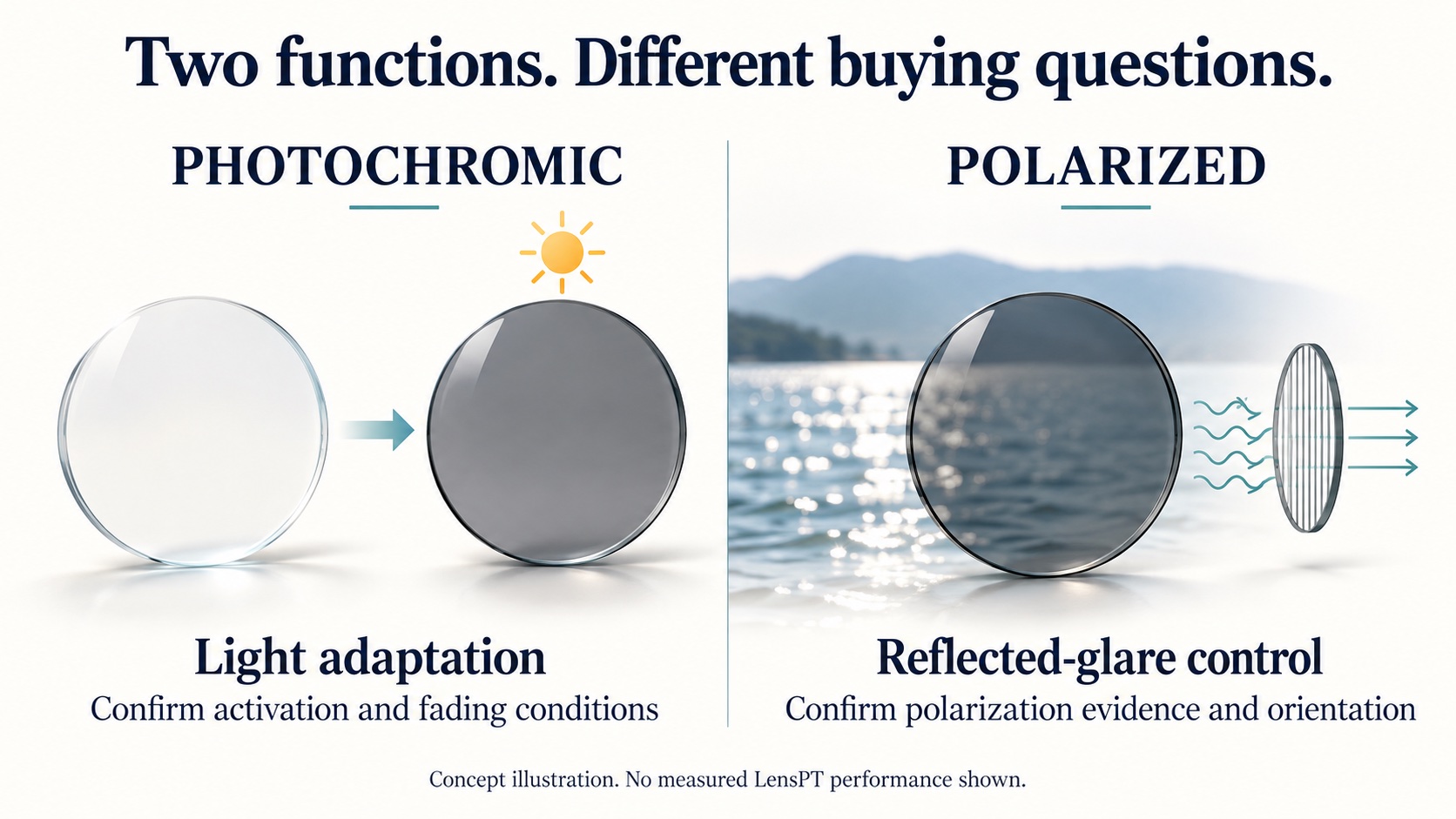
Photochromic lenses change their tint under activating light. Polarized lenses filter selected light orientations to reduce reflected glare. For optical buyers comparing photochromic vs. polarized lenses, the first decision is which function the eyewear range needs.
A distributor building an everyday optical assortment may be investigating light adaptation. A brand developing sunwear for reflective outdoor environments may be investigating polarization. A program can also require both, but that combination needs its own product specification and confirmation of availability.
Publisher disclosure: LensPT supplies optical lenses and publishes this guide. It draws on published product information and public manufacturer explanations, with an original purchasing framework. No physical lens testing or wearer trials were performed. The AI-generated images are conceptual illustrations, not LensPT product photographs or measured performance results.
What is the difference between photochromic and polarized lenses?
The difference concerns how the lens manages light. Photochromic describes a reversible change in tint under activating conditions. Polarized describes selective filtering of light according to its orientation. Neither term identifies the complete lens configuration.
In its explanation of polarized sun lenses, ZEISS describes filters that reduce horizontally oriented reflected light. Its discussion also notes situations involving digital screens where polarization management matters. Those explanations provide background; they do not establish performance for a LensPT product.
| Buying question | Photochromic route | Polarized route |
|---|---|---|
| Which function is being specified? | Tint adaptation under activating light. | Selective filtering to reduce reflected glare. |
| What evidence should the inquiry request? | Activation and fading results with the sample configuration and conditions stated. | Polarization performance and orientation information for the quoted configuration. |
| What does the name leave unresolved? | Whether the lens is polarized, its response in a vehicle, and its numerical tint-change performance. | Whether the lens is photochromic, its full transmission specification, and compatibility with the intended displays. |
| What belongs in both requests? | Lens design, material, nominal index, geometry, color, coating, intended use and destination market. | |
This table organizes a supplier discussion. It does not rank products or set acceptance limits.
Choose the function your eyewear range needs
Start with the use requirement before choosing a material or comparing unit prices. The following situations are hypothetical purchasing examples, not LensPT customer cases.
An assortment intended for changing light conditions
If the program calls for a tint that changes with the lighting environment, investigate a photochromic configuration. Define where the adaptation is expected to occur and which clear-state appearance, activated tint and fading behavior the buyer wants evaluated. Keep those requirements attached to the exact design, material and coating.
A sunwear program concerned with reflected glare
If reflected glare is a central requirement, investigate a polarized configuration. Request the relevant performance evidence and identify the intended use. Keep tint color, transmission requirements and coating choices in separate fields so the word “polarized” does not stand in for the whole order.
A program requesting both functions
Specify photochromic behavior and polarization separately. Ask whether the supplier offers that combination in the required design, material and geometry, and what documentation supports each function. A supplier listing the two product families separately has not thereby confirmed a combined product.
For an assortment decision, retain separate candidate records for each route. Comparing candidates with different functions may help define the range, but it should not be presented as a controlled performance test.
Check vehicle conditions and screen visibility separately
An outdoor photochromic result does not establish behavior behind a windshield. Ask for evidence covering the intended vehicle condition, including the light exposure, temperature and sample configuration. Transitions’ technology explanation distinguishes its named technologies by their response to activating light, including a technology designed to respond to visible light. A feature described for that branded product must not be assumed for another lens.
For polarized samples, include the actual displays relevant to the program in the review. Record the device, viewing angle, lens orientation and observed readability. A sample check on one display should remain tied to that setup rather than becoming a claim about every screen.
These are product-evaluation questions. This guide does not determine driving suitability, prescribe a lens for an individual wearer or establish destination-market compliance.
Compare evidence before approving samples
Give each candidate a sample ID and specification revision. Ask the supplier to connect its documentation to that same configuration. The review then has a traceable object instead of an unspecified “gray lens.”
For a photochromic candidate, request the activating light conditions, temperature, observation times, starting state and fade-back endpoint. Use our photochromic lens buying guide for the detailed comparison record.
For a polarized candidate, ask which method and report describe its polarization performance and how orientation is specified or controlled. Have the buyer’s technical owner resolve any missing method or acceptance limit with the supplier before approval. A visual demonstration can identify a question; the purchasing record should state the evidence used to answer it.
Review color, transmission requirements, surface appearance and the required UV documentation separately. Avoid treating a darker photograph as proof of polarization, photochromic speed or UV protection. If photographs are retained for appearance approval, record the lighting and reference used.
Review LensPT’s published product routes
The following fields come from two existing LensPT listings. They identify starting points for an inquiry, rather than interchangeable test samples or confirmation that every combination is available.
| Published field | PC Photo Gray Lenses | Polarized Lenses |
|---|---|---|
| Function or design | Photochromic single vision, gray treatment. | Polarized lens. |
| Nominal refractive index | 1.59. | 1.499, 1.56 and 1.61. |
| Material identification | Polycarbonate. | The listing does not state a substrate name; request it for the quoted item. |
| Listed coatings | HC, HMC and custom coatings. | HC, HMC and custom coatings. |
| Order details highlighted | Blank type, diameter, coating, darkened color, quantity and packaging. | Lens specification, color reference, base curve, diameter, quantity and packaging. |
Sources: 1.59 PC photo gray lens specifications and polarized lens specifications, checked October 26, 2026. Confirm the current product code, available configuration and quotation scope for the intended order. A nominal index alone does not identify a material.
These listings do not confirm a combined photochromic-polarized LensPT product. If both functions are required, make that an explicit availability question.
Send a function-specific lens inquiry
Keep the first inquiry short enough to review, while making the unresolved decisions visible. Copy the record below into your inquiry and replace each instruction with your requirement.
| Field | Information to provide |
|---|---|
| Program and intended use | Assortment or eyewear program, use conditions, and plano or prescription requirement. |
| Required function | Photochromic, polarized, or both; identify any open choice. |
| Product configuration | Design, material or nominal index, color, diameter, base curve where relevant, coating and requested supply format. |
| Evidence requested | Function-specific reports, comparison conditions, appearance reference and proposed sample-review criteria. |
| Commercial scope | Quantity, packaging, destination market and requested delivery scope. |
| Open questions | Unconfirmed fields and the person responsible for resolving them. |
For a sun-lens program that also needs geometry, color references and a sample-approval record, use the sun lens RFQ checklist. That checklist has a CR39 plano sun-lens scope; adapt the fields to the actual product and do not carry its material assumption into a PC or other lens request.
Questions buyers ask
Are photochromic lenses polarized?
Photochromic describes tint adaptation. It does not confirm polarization. Request a product specification that identifies each required function.
Can a lens have both functions?
Commercial products combining the functions exist; Transitions XTRActive Polarized is one manufacturer example. Availability is product-specific. Ask for the exact combination, design and supporting documentation; do not infer LensPT availability from another manufacturer’s range.
Which route should an optical buyer choose?
Choose the function that addresses the program’s defined use, then evaluate the actual configuration and evidence. An assortment may include both routes for different needs. The approval record should show why each item was selected.
Discuss your lens requirements with LensPT
Send the intended use, required function, lens design, material or nominal index, color, diameter, base curve where relevant, coating, quantity, packaging and destination market. Include the sample evidence you want reviewed and any configuration questions still open.
Contact LensPT to discuss your photochromic or polarized lens requirements. Ask for written confirmation of the available configuration and commercial scope before treating a product listing as the agreed order specification.