
Blue cut progressive photo gray lenses combine three features: a progressive optical design, blue-light filtering, and a gray photochromic tint. These features describe different aspects of the lens. The progressive design provides different viewing zones, the blue-cut feature changes the transmission of selected wavelengths, and the photochromic treatment changes the tint under activating light.
For optical distributors, retailers, and eyewear brands, understanding that distinction makes the product easier to describe and specify. Adding a treatment does not identify the progressive design, and a dark lens photograph does not tell you its filtering performance.
LensPT publishes this guide as an optical lens supplier. It draws on product specifications and public reference material; no physical lens testing was performed for this article.
Progressive: Distance, Intermediate, and Near Zones
A progressive lens changes optical power gradually between its distance and near areas, with an intermediate region along the progression corridor. It has no visible bifocal segment line. The layout and usable viewing areas depend on the particular design; a diagram should not be read as a promise of identical vision across the entire lens.
ZEISS’s explanation of progressive lenses describes the progression corridor and illustrates why different designs can emphasize different viewing needs. Its named technologies are specific to ZEISS, rather than specifications for LensPT products.
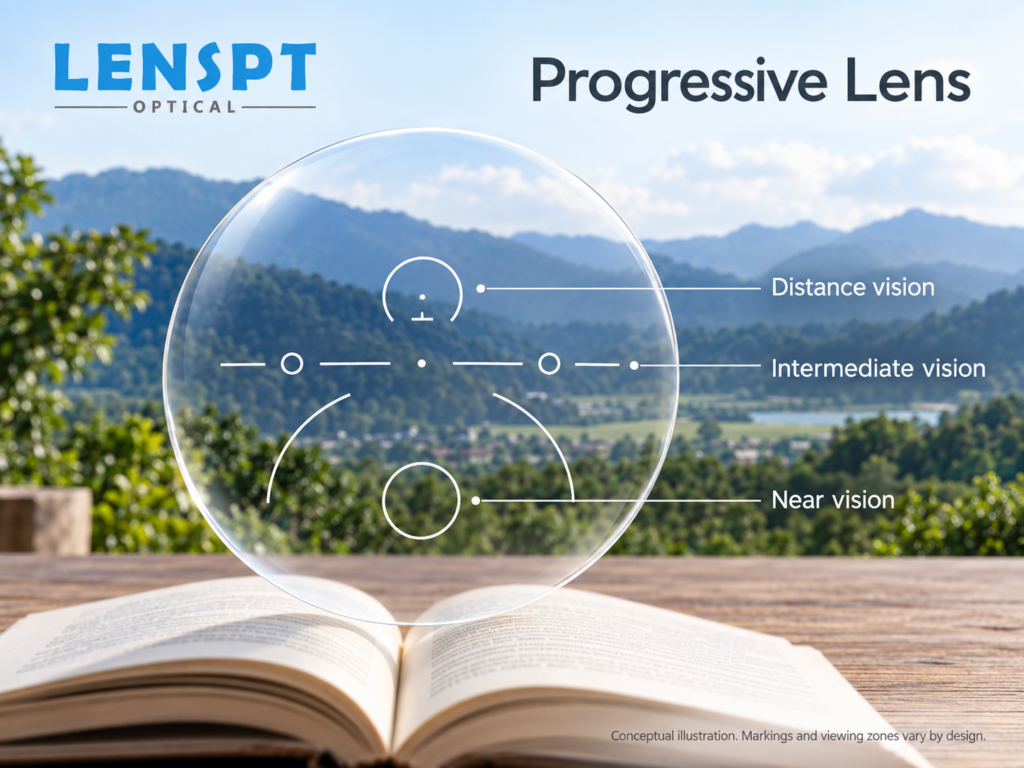
A circular lens illustration for B2B product communication. Viewing zones and reference markings are schematic and vary by design; this is not a fitting or production layout.
The circular outline represents a lens before it is edged to a frame shape. The illustrated markings help orient the explanation. They do not establish a corridor length, addition power, minimum fitting height, or a particular product’s engraving pattern.
For an actual order, identify the selected design and use the supplier’s corresponding documentation. Our progressive lens ordering guide explains how to keep product, wearer, frame, and laboratory information separate.
Blue Cut: A Filtering Feature
“Blue cut” refers to reducing transmission within selected short-wavelength portions of visible light. The product name does not state how much is filtered, which wavelength range is covered, or whether the filtering function is in the material, the coating, or a combination.
Blue-light filtering and anti-reflective treatment also describe different functions. A supplier may offer them together, but one term should not stand in for the other when discussing a configuration.
This matters when reviewing photographs. A blue or violet reflection is an appearance characteristic, not a complete spectral transmission report. To describe a filtering percentage, use data for the exact product and state the wavelength range and measurement conditions.
Our blue cut lens guide covers those distinctions in more detail. Here, blue cut identifies one part of the combined product specification; it is not presented as a medical benefit or a guarantee of screen comfort.
Photo Gray: A Light-Adaptive Gray Tint
Photo gray describes the gray photochromic feature. Unlike a fixed tint, photochromic coloration changes in response to activating light and fades as conditions change. The progressive design continues to describe the viewing zones; the changing tint describes a separate function.
The LensPT product page describes this configuration as clear or lightly tinted indoors, with outdoor darkening according to its photochromic specification. That description does not provide a numerical activation time, fade-back time, or darkened transmission value.
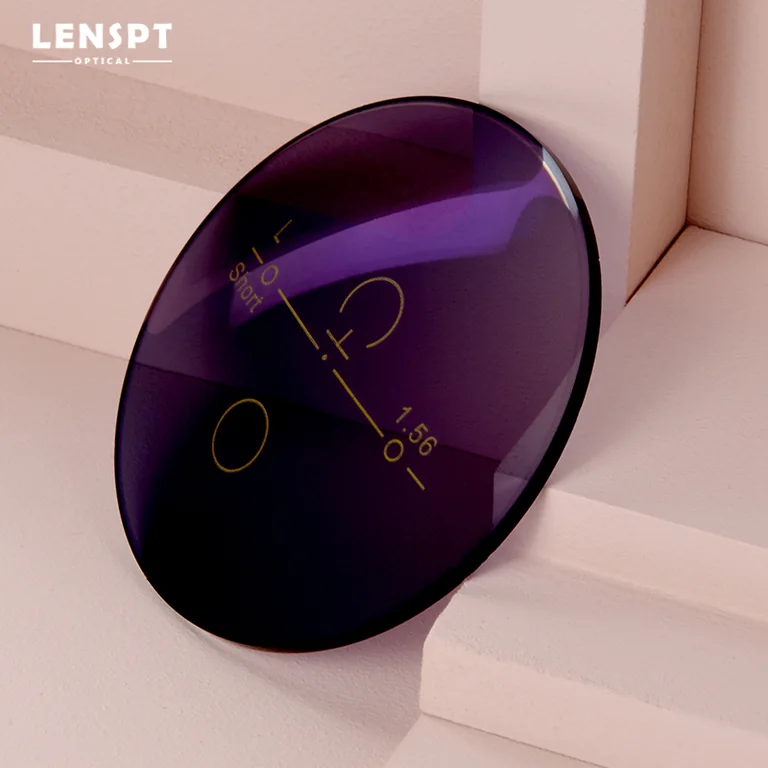
LensPT product photograph. The recorded color and reflections show appearance under the photographic conditions, not measured tint depth or filtering performance.
For questions about speed or darkness, ask for the product-specific results and test conditions. Avoid applying a result from another material, coating, or photochromic product to this configuration. Our photochromic lens buying guide explains how to compare activation conditions and fading endpoints.
How the Features Fit Together
Keep the features in separate fields when describing the lens to a customer or supplier:
| Feature | What it describes | What the name alone does not establish |
|---|---|---|
| Progressive | Gradually changing optical power and viewing-zone design | Corridor dimensions, prescription range, or fitting requirements |
| Blue cut | Filtering of selected short-wavelength visible light | A blocking percentage, spectral profile, or health outcome |
| Photo gray | A photochromic gray tint | Activation speed, fade-back speed, or performance in every lighting condition |
| Coating option | The specified surface-treatment package | The complete blue-cut or photochromic performance of the finished lens |
These functions can be combined, but their names are not interchangeable. A clear progressive lens is still progressive. A photochromic lens is not necessarily progressive. Blue cut progressive lenses do not automatically include a photochromic treatment; that feature must be specified.
Likewise, the term “photochromic progressive lenses” describes a broader category than the particular blue-cut photo-gray configuration discussed here. Use the full product designation when the combination matters.
The LensPT 1.56 Configuration
The Blue Cut Progressive Photo Gray Lenses product page lists:
- Optical design: Progressive / multifocal.
- Nominal refractive index: 1.56.
- Treatments: Blue cut and photochromic gray.
- Coating options: HC, HMC, SHMC, and custom coatings.
The nominal index is not a material name. The published listing does not specify the substrate, so it should not be labeled polycarbonate or another material without confirmation. Similarly, a listed coating option is a starting point for discussion, rather than evidence that every possible design-and-coating combination is available.
For this product, LensPT requests details including progressive design, corridor length, diameter, coating, darkened color, quantity, and packaging. Supply the requirements you already have and identify the remaining questions. The sales team can confirm the current configuration and quotation scope.
Discuss the Combined Configuration with LensPT
When contacting us, name Blue Cut Progressive Photo Gray Lenses, nominal index 1.56, then specify your design and coating requirements. Include your order quantity, packaging needs, and destination market so the inquiry can be reviewed in context.
Contact the LensPT sales team for current specifications and quotation details. Keeping the three functions distinct helps both sides discuss the same lens configuration from the start.