
By LensPT Team
Round-top bifocal lenses have a rounded near segment; flat-top bifocal lenses have a near segment with a straight upper edge. These names describe the segment inside the lens, not the shape of the uncut lens blank or the finished frame.
For optical distributors and purchasing teams, the useful comparison starts with the required viewing arrangement. Then compare segment geometry and confirm the material and treatments for the selected product. A request for a blue cut lens alone leaves the optical design unspecified.
Publisher disclosure: LensPT supplies optical lenses. This comparison draws on published product specifications and professional optical references. It includes no physical lens testing or wearer trials, and no additional commercial partnership is associated with this article.
Round-top vs. flat-top: where the shape matters
A round segment narrows toward its curved upper edge and widens below it. A flat-top, also called a D-segment, provides its segment width immediately below the straight top. The Association of British Dispensing Opticians explains this difference in its bifocal design guidance.
That geometry is useful when comparing specifications, but it does not establish that every flat-top product has a larger usable near field than every round-top product. Compare the actual segment dimensions and position, rather than treating the shape name as a field-of-view measurement.
Both are bifocal designs with two designated prescription regions, commonly distance and near. Occupational configurations can use different combinations. Round segment bifocal lenses and D-segment lenses share that arrangement.
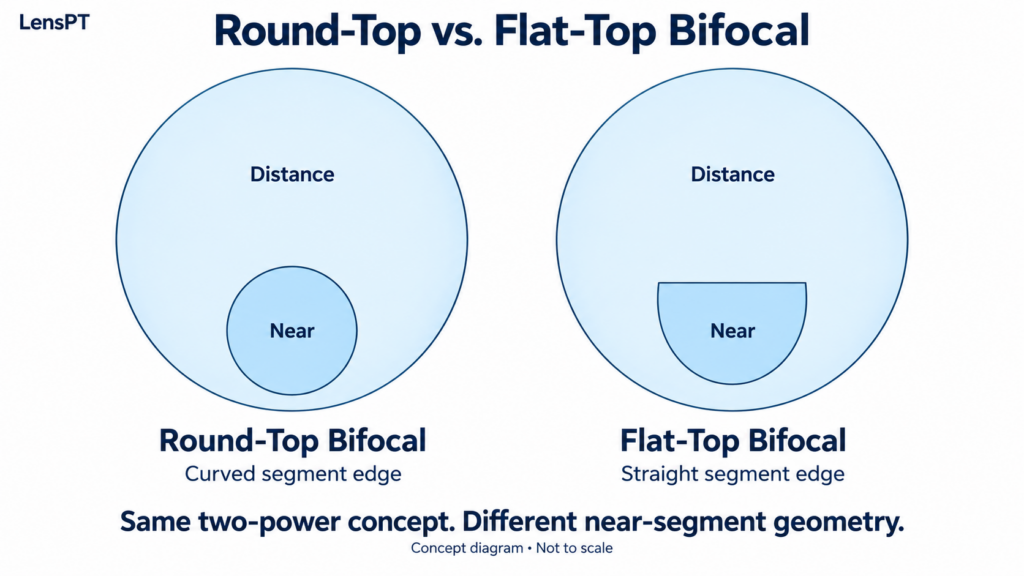
Concept illustration, not a production drawing. The circular outlines represent lens blanks; the internal shapes show design differences. Zone sizes and positions are illustrative.
Compare the four designs on the same terms
The table uses conventional distance-and-near bifocals as the reference. It compares design characteristics, without scoring brands or prescribing a lens for an individual wearer.
| Design feature | Round-top bifocal | Flat-top bifocal | Progressive | Single vision |
|---|---|---|---|---|
| Near-area geometry | Rounded segment | Segment with a straight upper edge | Near region connected through a changing-power corridor | No added near segment |
| Focal arrangement | Two designated regions | Two designated regions | Distance, intermediate, and near regions | One prescribed viewing purpose |
| Visible bifocal boundary | Yes | Yes | No bifocal-style dividing line | No bifocal segment |
| Separate intermediate region | Not in the conventional distance/near design | Not in the conventional distance/near design | Intermediate power along the corridor | Can be prescribed for an intermediate task, but remains single vision |
| Design detail to identify | Segment shape and dimensions | Segment shape and dimensions | Named design and corridor requirements | Intended prescription purpose |
The distinction between separate powered regions and a gradual transition is described in ZEISS’s multifocal lens overview. ABDO’s spectacle lens guide explains how progressive designs provide intermediate vision and how their zone arrangements can differ. LensPT’s single-vision product description identifies distance, near, and task-specific prescription purposes.
“No dividing line” describes the optical regions of a progressive lens. It does not mean that a lens has no identification or fitting markings.
Use the comparison to narrow a product inquiry
Our suggested selection order is viewing arrangement, segment geometry, then product configuration. This is an editorial framework for organizing a supplier discussion, not a performance ranking.
Start by separating two requirements: distinct distance and near regions, or a design that also includes a continuous intermediate transition. For the first, round-top and flat-top are relevant candidates. For the second, moving from one bifocal segment shape to the other does not add that transition; the discussion should include progressive designs.
The absence of a third dedicated region in a conventional bifocal should not be described as an inability to see anything at intermediate distances. The table describes lens architecture, rather than predicting an individual wearer’s vision.
A request centered on one prescribed viewing purpose brings single vision into the comparison. It should not automatically become a bifocal request simply because other products in an assortment have near segments.
Once the design category is clear, record the chosen geometry separately from the material and treatments. For example, a round-top inquiry can name the desired segment configuration while leaving an unconfirmed coating combination for the supplier to resolve. This keeps a design decision visible when the quotation changes.
For the subsequent laboratory information handoff, use the separate progressive ordering checklist. It addresses order inputs and responsibility; the comparison here addresses which design category the inquiry concerns.
What LensPT currently lists for round-top bifocals
The LensPT round-top bifocal product page lists nominal refractive indices of 1.499 and 1.56, with UC, HC, HMC, and other lens treatments. The public listing does not specify a substrate name or numerical segment, prescription, and ADD ranges. Request those details for the configuration being quoted.
For comparison, the PC flat-top bifocal page identifies 1.59 polycarbonate, with HC, HMC, and custom coating options. Those specifications belong to that catalog product.
The clear progressive range lists nominal indices of 1.499 and 1.56, with HC, HMC, or custom coatings. Corridor dimensions require confirmation for the chosen design.
If you are sourcing blue cut round-top bifocal lenses, ask LensPT to confirm that exact combination. Blue Cut is not explicitly listed as a confirmed configuration on the current round-top page. Do not carry the specification of a blue cut progressive or single-vision product across to a round-top order. The separate blue cut lens guide explains the filtering questions buyers can raise once availability is confirmed.
Ask LensPT for the current round-top bifocal specification and available configurations. Name the design being considered and identify any unresolved segment, material, or treatment requirement so the sales team can confirm the scope of the quotation.